
The aircraft get the headlines. The electrical infrastructure gets the headache.
Urban air mobility is no longer gathering pace — it is arriving. In June 2025, Skyports Infrastructure opened the United Kingdom’s first operationally complete vertiport at Bicester Motion in Oxfordshire: a 160-square-metre terminal housing automated passenger processing, airspace monitoring, and charging infrastructure sized for Vertical Aerospace’s VX4 prototype. In Dubai, the DXV — a four-storey, 3,100-square-metre facility at Dubai International Airport — reached structural completion in November 2025, targeting commercial operations with Joby Aviation’s S4 aircraft in 2026. The concept, in other words, is no longer conceptual.
But behind the imagery of vertiports opening lies the same engineering challenge that has defined this sector from the beginning: how do you actually power these facilities?
A single eVTOL charging stand operating at rapid-turnaround speed requires, at minimum, 500 kilowatts. That figure comes not from a modelling exercise but from Ali Ilyas, head of electrification at Skyports Infrastructure, speaking from the design work behind Bicester and projects in development beyond it. At the upper end, Joby Aviation’s S4 has demonstrated 1.2 megawatts of charging power in test conditions. The FAA’s Engineering Brief 105A, published in December 2024, sets a current planning baseline of one to two megawatts per charging pad. A four-pad commercial vertiport running simultaneous fast-charging sessions could therefore demand eight megawatts or more — placed on a rooftop, in the middle of a city, connected to a distribution network that was never designed for it.
This is where electrical design becomes city design. The National Renewable Energy Laboratory and FAA Vertiport Electrical Infrastructure Study — still the most comprehensive public analysis of this challenge — found that vertiport charging increased site electrical demand by between 200 and 1,100 per cent across modelled sites, and triggered grid upgrade requirements at every single site analysed. Not some sites. Every site.
That is not an aviation planning footnote. That is the engineering challenge that will determine whether urban air mobility scales beyond a concept.

What Makes a Vertiport Different
A vertiport is not a heliport with a charging cable attached. It is not an EV charging hub that happens to serve aircraft. It occupies a distinct and demanding category of electrical infrastructure — one defined by high-power, intermittent, concentrated demand, combined with the safety and power quality requirements of both aviation and high-voltage electrical engineering.
The charging power requirement is driven fundamentally by turnaround time. eVTOL operators are targeting 15 to 30-minute turnaround cycles to make urban air mobility commercially viable. Achieving that with battery-powered aircraft requires DC fast charging at or above 500 kilowatts per stand. At the DXV vertiport in Dubai, each charging stand is equipped with Joby’s Global Electric Aviation Charging System — a purpose-designed solution that shifts liquid cooling apparatus from the aircraft to the ground station, reducing aircraft weight and enabling the 1.2 megawatt charging rates that Joby’s S4 has demonstrated at test facilities. That figure is at the boundary of what conventional electrical distribution equipment is designed to handle from a single connection point.
As operational tempo increases — aircraft cycling through every fifteen to thirty minutes rather than every few hours — power demand does not grow linearly. It spikes. And spikes at this scale have consequences that extend well beyond the vertiport boundary.
Volocopter’s VoloPort concept, demonstrated at full scale in Singapore in 2019 in collaboration with Skyports, illustrated this challenge directly. Designing the vertiport footprint and charging bays was the visible work. Designing the electrical supply to sustain simultaneous operations at urban locations was the invisible but critical constraint. That constraint has not eased. In every project that has followed, it has grown more acute.
The Load Planning Challenge
Coincident Demand and the Diversity Factor
Consider a vertiport with four charging stands, each drawing 500 kilowatts at simultaneous peak charge. The theoretical peak demand is 2 megawatts before terminal HVAC, lighting, passenger systems, and emergency power are added. In practice, operational scheduling and on-site battery storage can reduce the coincident demand presented to the distribution network. But the grid connection must be designed for the credible worst case, not the operational average. Undersizing it is not a recoverable error.
Published cost data for what that worst case costs to address has begun to emerge. Distribution line upgrades for an urban vertiport site run from £6 million to £13 million per site. Transformer upgrades run from £400,000 to £1.6 million. Urban substation upgrades average £2.5 million to £4 million per location before network operator margins and programme contingency. Equipment costs alone for a minimum-scale installation run from approximately £36,000 to £180,000 before civil works, permitting, or connection charges. A developer who does not factor this range into early feasibility is building a financial model on an unverified assumption.
This is where load planning for a vertiport departs from conventional building services engineering. In commercial buildings, diversity factors are well-established and supported by decades of operational data. For vertiports, operational schedules are still being defined, aircraft types are still being finalised, and charging standards are not yet harmonised across manufacturers. The electrical design cannot be divorced from the route planning, aircraft selection, and operational business model. That integration of disciplines is a new requirement in the built environment, and it demands early collaboration between electrical engineers, aviation planners, and operators.
Grid Connection Strategy
At one to five megawatts of total demand, a vertiport connects into high-voltage territory — typically 11 kV or 33 kV — engaging the Distribution Network Operator at a level of complexity that most building developers have not previously encountered. The engineering challenge has not changed. The regulatory environment around it has.
In April 2025, Ofgem formally approved the NESO Connections Reform Package — known as TMO4+ — replacing the old first-come, first-served queue with a “first ready and needed, first connected” model. The direct implication for vertiport developers is significant: a connection application will no longer hold its place in queue without demonstrating planning consent, land rights, and financial commitment. Speculative positions are not protected. A developer entering the queue must be ready to proceed, not merely interested in proceeding.
The scale of competing demand gives context to the environment vertiport developers are entering. The demand connections queue grew by 84 gigawatts at transmission level between late 2024 and mid-2025, driven overwhelmingly by data centre applications. A vertiport requiring a new HV or EHV connection in an urban area is queuing alongside the largest demand applicants in the country, with no preferential treatment and no aviation-specific framework to navigate by.
Connection timelines are now more quantifiable, and the data is not reassuring. NGED’s Major Connections Annual Report, published August 2025, records an average of 122 to 357 working days from connection offer acceptance to energisation for distribution-level connections. At the HV and EHV tier in congested urban networks, the figure extends beyond 1,300 working days in the most constrained areas — more than five years. The three-to-five year DNO reinforcement lead time warning that this series first raised remains accurate. In some locations, it understates the reality.
Alternative strategies are gaining traction as a result. The private wire and vertiport microgrid model — on-site generation, battery storage, and intelligent load management — reduces the firm capacity being requested from the network, which is often the variable that determines whether costly reinforcement is triggered at all. The most immediately replicable template is multi-party cost sharing. A proposed project in the Dallas area has structured a shared substation arrangement between a vertiport, an adjacent AWS data centre, and a public EV charging hub, splitting an estimated $8.3 million substation upgrade cost across three tenants. The data centre’s stable 24/7 baseload complements the vertiport’s intermittent peak-clustered demand, improving the utilisation efficiency of the shared infrastructure. In the UK, equivalent opportunities exist adjacent to large logistics parks, EV fleet depots, or district energy schemes where substation investment can be pooled.
For any UK site assessment, NGED’s Network Opportunities Map — launched March 2025 — now shows available capacity headroom at bulk supply points, primary substations, and distribution substations across the network, including contracted positions. It is the practical starting point for site scouting, not a substitute for formal DNO engagement.
Power Quality
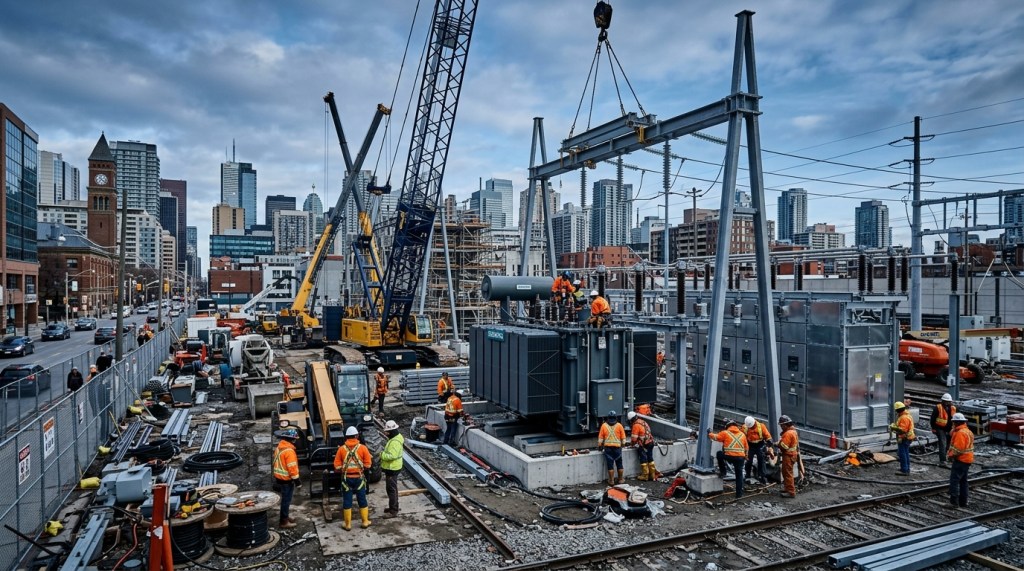
High-power DC fast chargers are not passive loads. They use power electronic converters — AC/DC rectification with pulse-width modulation control — and generate harmonic distortion as a byproduct. At vertiport scale, with multiple 500 kilowatt to 1.2 megawatt converters operating simultaneously, harmonic injection at the point of common coupling becomes a compliance matter under Engineering Recommendation G5/5.
G5/5 is the UK framework governing the impact of harmonic-generating equipment on the public distribution network. It has not been substantively revised since 2020, and no vertiport-specific supplement to it exists. A vertiport with multi-megawatt charging loads will almost certainly require a Stage 3 assessment — a site-specific process involving the DNO that requires detailed equipment data and may impose conditions on the design before connection is approved.
The NREL/FAA study described vertiport charging demand as “intermittent and spiky” and confirmed that voltage dips from peak charging events can affect distribution to neighbouring loads on the same substation. At Teterboro Airport in New Jersey, NREL’s modelling found that adding eVTOL charging pushed the existing transformer to 672 per cent of rated capacity, with minimum feeder voltage dropping to 0.77 per unit against an ANSI minimum of 0.95. The structural problem is the same in UK networks, even if the specific thresholds differ.
Mitigation strategies are well-understood from adjacent applications. Active Front End converters significantly reduce harmonic injection compared to passive diode bridge rectifiers. Active Harmonic Filters at the main switchboard address residual distortion. Power factor correction maintains voltage regulation under high-reactive loading. These solutions exist and are available. They must be specified at design stage. Retrofitting harmonic mitigation to an operational rooftop vertiport is not a practical option.
What Real Projects Are Showing
The Bicester Motion vertiport, which reached operational completion in June 2025, is the United Kingdom’s first complete vertiport facility and currently its most direct evidence base for what construction actually involves. What it cannot yet provide is data on commercial-scale electrical demand: the facility is a research and demonstration testbed, operating under the UKRI Future Flight Challenge programme, sized for prototype flights and light charging operations rather than the sustained multi-megawatt loads of a revenue-generating service. The consortium structure shields the project from the commercial grid tariff pressures and connection cost exposure that a developer seeking a DNO connection for commercial operations would face. Bicester is where operational questions are being answered. The electrical questions at commercial scale are being answered elsewhere.
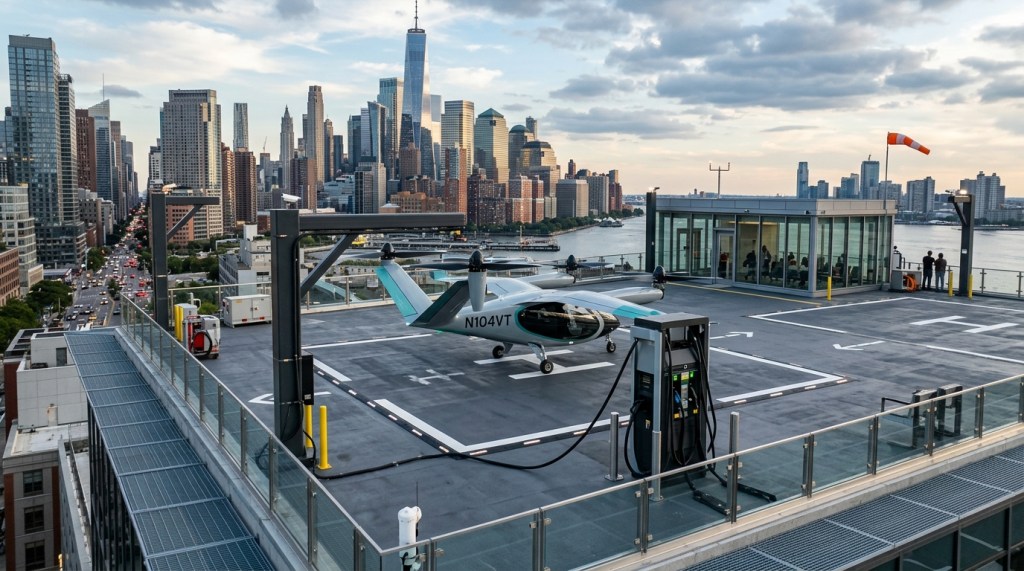
Dubai’s DXV — a four-storey structure designed for 42,000 aircraft movements and approximately 170,000 passengers per year — is the world’s most advanced commercial vertiport in construction. It will be the first facility where the electrical design assumptions of this sector are tested at anything approaching commercial throughput. GEACS charging infrastructure per stand, co-located within Dubai International Airport’s existing heavy-load electrical supply, gives the project a material advantage that most urban vertiport sites will not share: the grid connection draws on an existing airport power infrastructure rather than a new application to a congested urban network. The operating data from DXV’s first years will carry significant weight for every developer who follows.
In New York, the Downtown Manhattan Heliport has undergone operator transition to Downtown Skyport — a joint venture of Skyports Infrastructure and Groupe ADP — with eVTOL charging infrastructure in design and permitting as of 2025. The structural parallel with NREL’s modelling is direct: a legacy heliport in a dense urban environment, transitioning to high-power eVTOL charging, facing exactly the transformer and feeder adequacy questions the study identified. At Teterboro Airport — a comparable legacy aviation site — NREL found the existing transformer reaching 672 per cent of rated capacity under eVTOL load. Design and permitting at the Manhattan site must navigate that same problem in one of the most constrained urban electrical environments in the United States.
In Europe, the European Union Aviation Safety Agency issued the world’s first vertiport design specifications in 2022, acknowledging that electrical infrastructure for battery-powered aircraft represents “an evolving area with few industry-specific standards.” That description remains accurate. No materially updated EASA vertiport specification was issued in 2025 or 2026. The Urban-Air Port demonstration at Coventry in 2022 — the first full-scale vertiport concept in the UK — brought the same questions into sharp focus for British practitioners: DNO connection applications, earthing strategies for rooftop TN-C-S supplies, protection coordination across the DNO boundary. Those questions are still being worked through without standardised answers.
Why Getting the Electrical Design Right Matters
The grid connection is, in many cases, the largest single infrastructure cost item in a vertiport development — and the one most frequently underestimated in early business cases. The published cost data now available supports that assessment directly: distribution line upgrades alone can reach £13 million per urban site. A developer who commits to a site without a grid connection appraisal is not merely deferring a question. They are building a financial model around an unknown that has a published range of several million pounds of potential variation.
Beyond capital cost, the demand charge problem adds a structural operating expense that many early business cases do not adequately model. eVTOL charging creates an intermittent, peak-clustered load shape — precisely the profile that commercial electricity tariff structures penalise through demand charges calculated on peak 15-minute or 30-minute intervals. NREL found demand charges responsible for the majority of Year 1 bill shock at test sites, with utility bill increases reaching 300 per cent in some modelled scenarios. Duke Energy’s NC-AM tariff, approved in North Carolina in January 2025, is the first utility-specific response to this problem: it offers vertiports demand charge relief in their first year of operations, time-of-use rates with off-peak incentives, and shared savings agreements for load-shifting performance. Early adopters report 18 to 22 per cent lower energy costs than standard commercial rates. No equivalent UK tariff exists as of April 2026 — a gap that will need to close as commercial operations approach.
Battery energy storage reduces peak demand charges by up to 40 per cent in NREL’s modelling, and co-located solar plus storage reached a record low cost of $57 per megawatt-hour in 2025. Skyports’ own remote management and scheduling system includes AI-driven charging orchestration that staggers aircraft charging to avoid coincident peaks, reducing the required grid capacity by an estimated 25 per cent. These tools do not eliminate the grid connection challenge. They reduce its cost and timeline impact — and they must be designed in from the start.
Future-proofing adds a further dimension. The 500 kilowatt to 1.2 megawatt per pad figures reflect current and near-term aircraft. The infrastructure installed today must carry capacity headroom for what arrives in five to ten years. Next-generation eVTOL aircraft — larger, longer-range, heavier battery packs — will demand more. The grid connection negotiated now is the one that will be operated within for decades.
Limits and Where the Field Is Still Maturing
There is no vertiport-specific section in BS 7671 or in any UK Engineering Recommendation. BS 7671 Amendment 3:2024, published July 2024, introduced clarifications relevant to high-power fixed charging installations and bidirectional protective devices — useful for BESS-backed vertiport charging systems — but contains no eVTOL-specific provisions. A further Amendment 4 is expected in 2026, covering stationary battery systems and functional earthing, which will be relevant to vertiport BESS installations but will not create a vertiport-specific regime. Engineers designing vertiport electrical installations continue to work from the EV charging guidance in Section 722, requirements for high-power fixed installations elsewhere in BS 7671, and the G5/5 framework — applying professional judgement to regulations not written with eVTOL charging in mind.
CAA CAP 2538, published April 2023, remains the UK aviation authority’s interim vertiport guidance. It references the need to engage with power companies on grid access and charging points in general terms but provides no electrical design specifications, load limits, earthing schemes, or power quality requirements. No replacement document has been issued. A design standard that specifies those requirements for UK vertiports does not yet exist.
The earthing constraint from Section 722 — prohibiting PME (TN-C-S) earthing for outdoor charging installations — remains unchanged and continues to be a meaningful design constraint on rooftop vertiports in urban areas, where the majority of LV supplies are TN-C-S. The solution exists in TT earthing or an alternative protective device arrangement meeting Section 722’s specific voltage and disconnection requirements. On a rooftop in a dense urban environment, the implementation is not trivial and must be resolved at design stage.
Protection coordination requires early engagement and remains an area where insufficient attention is paid. Urban HV networks carry high fault levels. The vertiport’s protection scheme — from the DNO point of connection down to the individual charging bay — must be coordinated from the outset. Fault level data is not always readily available at feasibility stage, and deferring this work is a common and costly mistake.
A new uncertainty has emerged at infrastructure design level that did not exist when this series began: the charging standards question. Two competing approaches are now being actively deployed. The Combined Charging System — backed by BETA Technologies, Archer Aviation, and Vertical Aerospace, which formally adopted CCS in March 2025 — derives from automotive practice, placing thermal management on the aircraft and using power line communication for data transfer. Joby Aviation’s Global Electric Aviation Charging System, being progressed through SAE International as ARP8486, places liquid cooling on the ground station, requires a 2.5 gigabit data connection as part of the charging infrastructure, and has demonstrated 1.2 megawatt charging rates — a capability the current CCS hardware cannot match. Neither SAE, IEC, EASA, nor the FAA has issued a binding standard specifying which approach a vertiport must support. A vertiport designed around CCS infrastructure will not be natively compatible with Joby’s aircraft. A vertiport designed around GEACS will not be natively compatible with the CCS fleet. That is a design decision that infrastructure planners must take before the regulatory answer has been given — and the choice has direct implications for plant room sizing, M&E scope, and data infrastructure requirements.
The aircraft themselves introduce a further uncertainty. Until ARP8486 is finalised and referenced in FAA or EASA certification material, there is no regulatory mandate for either standard. Designers and developers must build in flexibility — and engage with aircraft manufacturers directly on what their equipment will actually require.

Outlook: The Equation Is About to Change
Load planning, grid connection strategy, power quality, earthing, protection coordination, and now charging standard compatibility — these are the non-negotiable first layer of vertiport electrical design. The foundations. Without solving them, nothing that follows is possible.
Dubai’s DXV, when it moves into commercial operations, will be the first live test of whether a purpose-built, high-throughput charging facility can be grid-connected and operated at commercial scale. The operating data from that project — particularly on demand profile, power quality, and the performance of GEACS at sustained operational tempo — will carry significant weight for every developer who follows. In the UK, the Bicester testbed is doing its own work. The gap between testbed scale and commercial scale remains the question that neither project has yet answered.
The regulatory environment is also shifting. TMO4+ has changed the rules of engagement with DNOs. The connection queue is more competitive, more demanding of project readiness, and less forgiving of speculative positions than at any point previously. The developer who understands both sides of the electrical equation — what the aircraft needs, and what the network can physically and commercially deliver — enters those conversations with a materially different capability than the one who does not.
The second layer — on-site photovoltaic generation, battery energy storage, and AI-based load management that learns from operational patterns to smooth demand and reduce peak grid dependency — is the subject of Part 2 of this series. The grid connection problem does not disappear. But it becomes manageable in a way that the raw load numbers alone suggest it cannot be.
The smart grid is meeting the sky. The engineers who understand both sides of that equation are building a specialism that will matter significantly over the next decade.
Part 2 of this series covers on-site renewable generation, battery storage integration, and AI-driven load management for vertiport infrastructure.


