
Welcome, urban transformation architects and resilience pioneers! We stand at the threshold of a profound reimagining of our cities—not as static constructions of concrete and steel, but as dynamic, adaptive ecosystems capable of withstanding, responding to, and evolving through the unprecedented challenges of our era.
The Resilience Symphony: From Concept to Implementation
In our previous exploration, we examined the conceptual foundations of smart city resilience – the capacity of cities to resist, absorb, and evolve in the face of external shocks while safeguarding critical services. Now, we transition from theory to tangible implementation, where visionary frameworks become living solutions capable of shielding urban ecosystems against mounting climate pressures and infrastructural vulnerabilities.
Resilience in smart cities transcends conventional engineering. It represents a city’s dynamic capacity to anticipate, withstand, and recover from disruptions – whether natural disasters, infrastructure failures, or rapid social changes. Building on AI’s role as the master architect of this resilience, we explore how pioneering cities translate strategic blueprints into real-world orchestration of robust, adaptive systems.
AI’s Foundational Role in Resilience
- Predictive Maintenance: AI-driven analytics identify vulnerabilities in power grids, bridges, and water systems before failures occur
- Adaptive Energy Systems: Smart grids leverage machine learning to balance supply and demand, ensuring continuity of essential services
- Real-Time Crisis Response: AI synthesises data from sensors, social platforms, and emergency services to enable swift, coordinated interventions
In this journey, we shift focus to practical strategies, spotlighting how urban laboratories like Rotterdam and New York City serve as testbeds for resilience breakthroughs, forging living examples of how AI and advanced infrastructures bolster city ecosystems.
The Technological Trinity: Core Strategies for Urban Resilience
Infrastructure Fortification: Building the Resilient Foundation
Resilience begins with robust electrical systems and fortified infrastructure capable of withstanding extreme conditions. This approach, often described as “infrastructure with immune systems,” aims to strengthen vulnerable components to reduce the likelihood and impact of external shocks.
Key elements include:
- Underground Protective Networks: Relocating critical power lines beneath the earth’s protective mantle, shielding them from wind, ice storms, and falling debris
- Reinforced Transmission Architecture: Strengthening utility poles and transmission towers with advanced materials engineered to withstand extreme wind loads
- Elevated Critical Nodes: Raising substations in flood-prone areas above projected flood levels, creating islands of electrical continuity during water inundation events
- Intelligent Early Warning Systems: Sensor networks and AI-based anomaly detection to catch subtle signs of potential failure
Example in Practice: In the Netherlands, Alliander’s Smart Cable Guard system uses AI-powered sensors to detect partial discharges in medium-voltage cables, preventing over 250 outages and reducing recovery times by 20%. This system, deployed across critical grids, combines power-line modems with semi-supervised anomaly detection algorithms to localize defects within 1% of cable length. Recent expansions include 2,500 km of new underground cables laid in 2023, part of a €1.4 billion investment to enhance grid reliability.
Renewable Energy Integration: Diversifying the Power Portfolio
Resilience transcends sustainability when distributed renewable energy sources become core to an urban power strategy. By decentralising generation, cities reduce dependency on single points of failure, creating what resilience experts call “energy redundancy”—ensuring that even if one source falters, others can seamlessly step in.

Core approaches include:
- Localized Generation Networks: Deploying solar arrays, micro-wind turbines, and CHP systems across rooftops and community spaces, creating a tapestry of energy production
- Intelligent Energy Storage: Leveraging advanced batteries or thermal storage to buffer fluctuations and sustain power during grid disruptions
- AI-Orchestrated Distribution: Machine learning algorithms optimising renewable asset usage, foreseeing demand surges, and aligning generation with real-time weather data
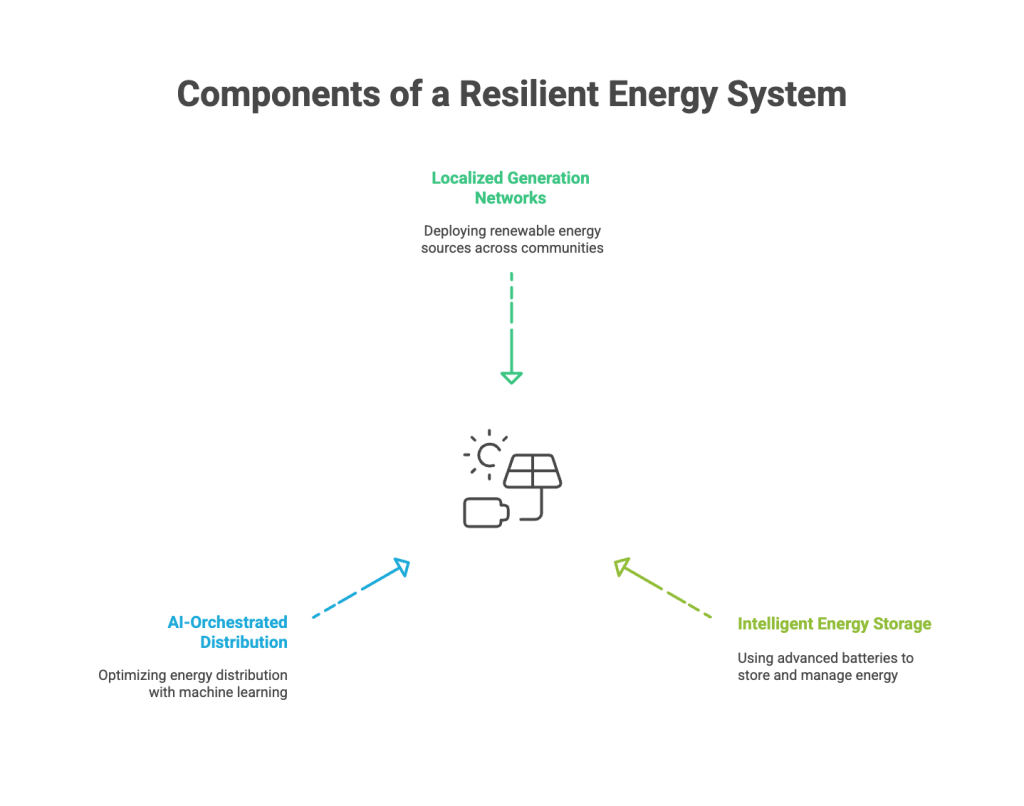
The benefits extend beyond resilience to include reduced greenhouse gas emissions and decreased energy system losses through localized generation—a perfect harmony of environmental stewardship and urban resilience.
Smart Grid Evolution: Creating the Responsive Nervous System
Where infrastructure fortification and renewables lay the foundation, smart grids function as the urban nervous system, enabling real-time adaptation to shocks:
- Real-time Data Analytics: AI examines consumption patterns, grid load, and renewable output, adjusting distribution with precision to maintain critical services
- Microgrid Archipelagos: Semi-autonomous energy “islands” ensuring critical facilities (hospitals, emergency services) remain powered even if the main grid goes down
- Predictive Maintenance Orchestration: Algorithms anticipate potential transformer or cable faults, scheduling targeted interventions to prevent cascading outages
Example in Practice: Contemporary smart grids now deploy convolutional autoencoder deep learning models for anomaly detection in underground cables, analyzing power spectral density (PSD) images to identify thermal damage in XLPE insulation. For example, CESC (India) uses a hybrid AI/ML model with 72% prediction accuracy to forecast HT cable faults by correlating dynamic parameters like load variance, soil conditions, and weather patterns. These systems process 378 million data points across 1,800 feeders to enable proactive maintenance.
Urban Laboratories: Learning from Pioneering Cities
Rotterdam: Engineering Resilience Through Innovation
Facing existential flood threats, Rotterdam has evolved into a living laboratory for urban resilience, employing AI-enhanced flood management, digital city modeling, and energy orchestration:
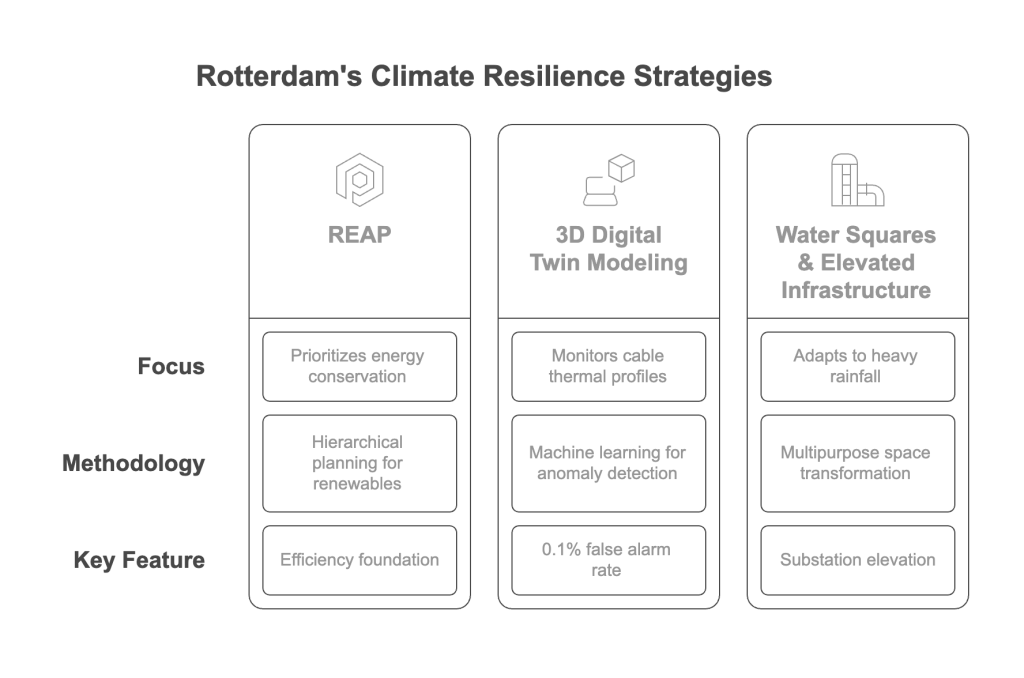
- Rotterdam Energy Approach Planning (REAP): A hierarchical methodology prioritising energy conservation before deploying renewables, creating an efficiency foundation upon which renewable systems can be optimally sized
- 3D Digital Twin Modeling: Rotterdam’s energy strategy now integrates Distributed Temperature Sensing (DTS) for submarine cables, using machine learning to correlate load currents with thermal profiles. This method identifies anomalies like cable resurfacing or insulation degradation by analyzing spatial-temporal temperature variations, achieving <0.1% false alarm rates in defect localization
- Water Squares & Elevated Infrastructure: Multipurpose community spaces that transform during heavy rainfall from vibrant public squares to water retention basins, coupled with strategic substation elevation above projected flood lines
Rotterdam’s ambition to be 100% climate-proof by 2025 offers a tangible blueprint of how synergy between AI, advanced infrastructure, and community engagement can yield robust, flexible systems capable of thriving under climate pressures—not merely surviving them.
New York City: Rising Stronger After Sandy
Hurricane Sandy (2012) exposed critical vulnerabilities in NYC’s electrical and transport infrastructure. Today, the city exemplifies a comprehensive AI-driven resilience strategy that transforms crisis into opportunity:
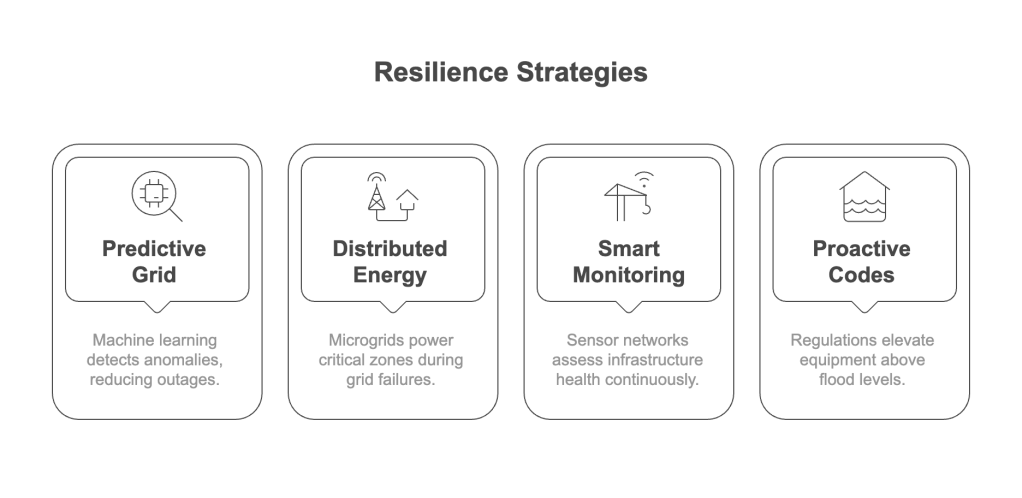
- Predictive Grid Intelligence: Con Edison’s infrastructure upgrades feature sophisticated machine learning to detect subtle anomalies before they cascade into failures, reducing prolonged outages by 30%
- Distributed Energy Backbone: Strategically positioned microgrids serve critical zones, ensuring hospitals and emergency shelters remain powered even during large-scale grid failures
- Smart Infrastructure Monitoring: Comprehensive sensor networks continuously assess structural health of bridges, tunnels, and roads, prompting preventative repairs before minor damages escalate into catastrophic failures
- Proactive Energy Codes: Post-Sandy regulations require elevating vital equipment above projected flood levels, transforming building codes from reactive guidelines to proactive resilience tools
New York’s transformation underscores how catastrophic events can catalyze systemic reinvention, leveraging AI and robust planning to create a city not merely recovered, but fundamentally reimagined for future challenges.
The Resilience Playbook: Lessons for Urban Transformation
Drawing insights from Rotterdam, New York, and other pioneering cities, a resilience playbook emerges—a symphony of approaches that, when orchestrated together, create urban environments capable of not just withstanding challenges but evolving through them:
1. Holistic System Integration
Combine physical hardening, renewable diversification, smart grid technologies, and AI analytics into a unified strategy that transcends siloed approaches to create integrated resilience ecosystems.
2. Multi-Dimensional Planning
Address hazards of multiple types (storms, floods, heatwaves), consider cascading failure scenarios across interdependent systems, and incorporate both short-term shocks and long-term stresses into resilience frameworks.
3. Collaborative Ecosystem Development
Foster partnerships across public agencies, private innovators, academic researchers, and community groups, ensuring cross-sector synergy that leverages diverse expertise and perspectives.
4. Forward-Looking Implementation
- Intelligent Infrastructure: Prioritize AI-enabled sensors and predictive analytics that transform static systems into learning networks
- Embrace Distributed Generation: Deploy solar, wind, and CHP solutions that create energy redundancy and local power security
- Establish Resilience Islands: Alliander’s municipal microgrids in San Diego demonstrate $6M savings over 25 years while powering police and fire facilities. These systems now prioritize cybersecurity protocols, as highlighted in DNV’s Smart Cable Guard framework, which uses encrypted real-time data streams to prevent digital intrusions in distributed energy networks
- Strengthen Cybersecurity: Implement robust protocols against digital threats in increasingly connected urban environments
5. Community-Centric Vision
Place public well-being at the heart of resilience strategies, involving citizens in co-design processes and ensuring equitable access to resources and technologies—recognizing that technical resilience without social resilience creates fundamentally fragile systems.
The Path Forward: From Resilient Cities to Resilient Societies
Artificial intelligence stands as the cornerstone of urban resilience, transforming how we forecast failures, orchestrate energy flows, and respond to emergencies. By harnessing AI’s analytical prowess and predictive capabilities, cities evolve from passive environments to proactive ecosystems, shaping their futures amid uncertainty rather than merely reacting to events.
As we construct tomorrow’s urban landscapes, we’re crafting living systems capable of learning, adapting, and thriving through each challenge they face. This transformation extends beyond physical infrastructure to spark a ripple effect, propagating innovation that not only protects the city but enriches its social fabric, fosters environmental stewardship, and enhances quality of life for every resident.
The journey toward urban resilience represents not merely a technical challenge but a profound opportunity to reimagine our relationship with the built environment. The experiences of trailblazing cities prove resilience is attainable where cutting-edge technology converges with inclusive governance and sustainability-driven policies. From underground power lines and solar arrays to AI-driven microgrids, these proven strategies illuminate what’s possible when visionary planning marries practical implementation.
By embracing these principles, we can create urban environments that emerge stronger, more adaptable, and more human-centric with each trial they face—fulfilling the true promise of smart city resilience in an uncertain, ever-evolving world.


 Energetic Dialogues