
Greetings, navigators of the emerging skies and stewards of future cities! As we glide into an era resonating with electric vibrations and newfound freedom from earthly constraints, let us gaze upon the exhilarating domain of Electric Vertical Take-Off and Landing (eVTOL) aircraft.
These marvels are not mere figments of a futurist’s imagination; they hold the potential to revolutionize urban mobility. Yet, they are still in the early stages of development, requiring further advancements in technology.

But what beats at the heart of this skyward saga? It’s the alchemy of charging technologies. Let’s orbit around this fascinating nucleus, with a special nod to the trailblazer, the Alia-250, for today’s exploration journey.
Within the eVTOL charging cosmos, we find a spectrum of techniques, each wielding its distinctive pros and cons:

- Conduction Charging: Reliable and economical, yet demanding, bound by cords and time consumption.
- Inductive Charging: The magic of wireless convenience, albeit at the expense of efficiency and a heavier purse.
- Battery Swapping: Offering a swift energy infusion, but troubled by complex logistics and the necessity for an expansive network of stations stocked with spare batteries.
Now, casting a spotlight back on the Alia-250 aircraft, developed by Beta. Picture a robust charging realm: a dispenser poised gracefully beside the landing site, with a rectifier unit performing modern-day alchemy, converting AC to DC, ensuring the eVTOL is amply juiced. The process utilizes a Combined Charging System (CCS) connector, elegantly coiled on a 50-foot retractable reel—a perfect union of form and function!
What makes the Alia-250 promising advancement in eVTOL realm? It’s the secret of its voracious energy consumption. Though charging specifications have not been officially confirmed, it is estimated to support fast charging capabilities, potentially utilising a 350 kW DC fast charger for rapid energy replenishment.
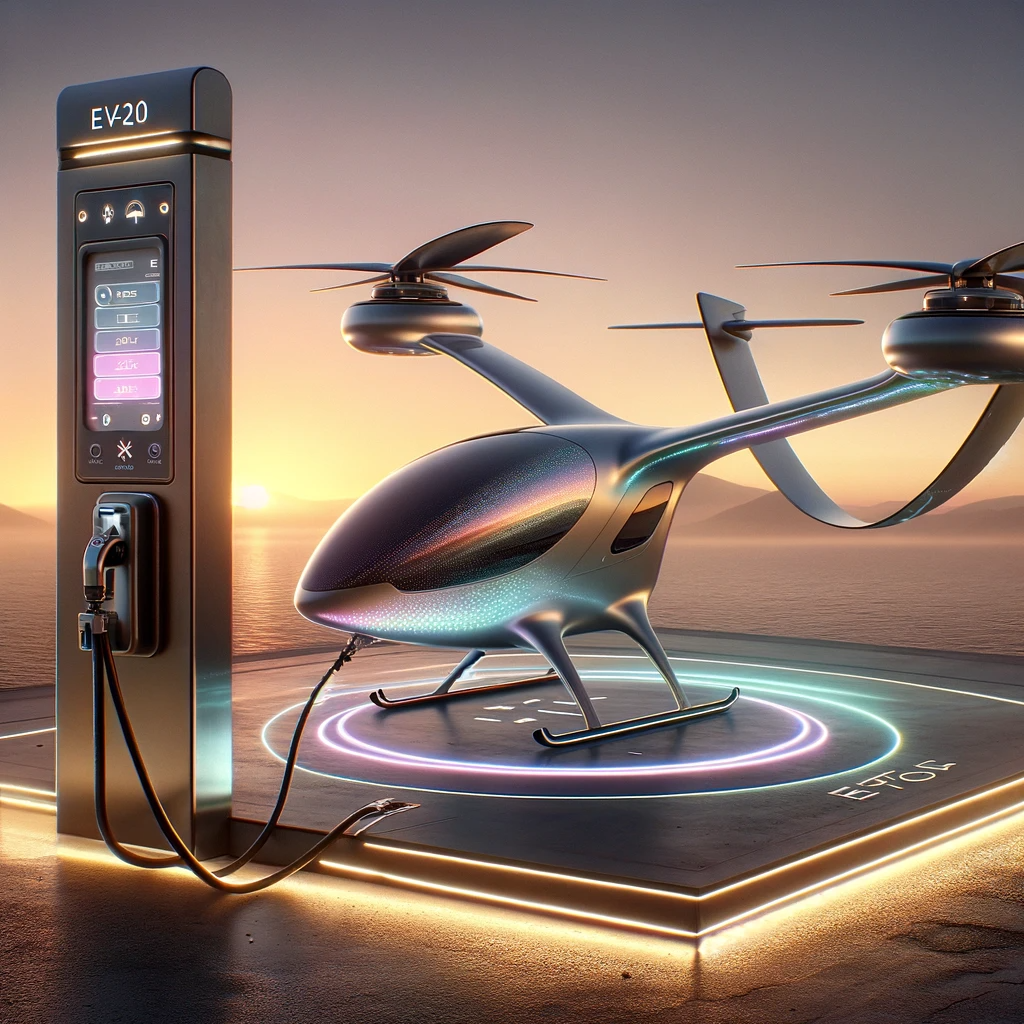
This symphony of speed and strength gifts the eVTOL a near-constant skyward gaze, minimizing earthly tethers. While the numerical ballet of the Alia-250’s charge rate and battery capacity remains under wraps, one can deduce that this eVTOL dynamo employs a high C-rate, allowing rapid energy quaffing. It’s this seamless synergy that fine-tunes eVTOL efficiency.
Strap in tight, for the horizons call to us with a tapestry of alluring prospects and intricate challenges.
As eVTOLs ascend from the canvas of dreamers to the pinnacle of urban conveyance, advancements in charging infrastructures, the alchemy of battery technology, and the development of universal charging lexicons stand as the next frontiers.
Will conduction charging become the chosen companion for brief aerial trips? Could inductive techniques serenade the wings for long-distance journeys? Might battery swapping emerge as the vital pulse for our tireless guardians of the skies
The goal is to shave off the pauses for power-ups, enhancing the rhythm of skyborne ballet, edging ever nearer to a cityscape alive with agile, environmentally savvy mounts.

So there we have it, fellow aeronauts: the galactic leaps in charging technologies, as epitomized by celestial cruisers like the Alia-250, are nudging us closer to a skyward future—clean, efficient, and liberated from terrestrial gridlock. Let’s keep our gaze skyward; the celestial tapestry is still being woven.


 Energetic Dialogues